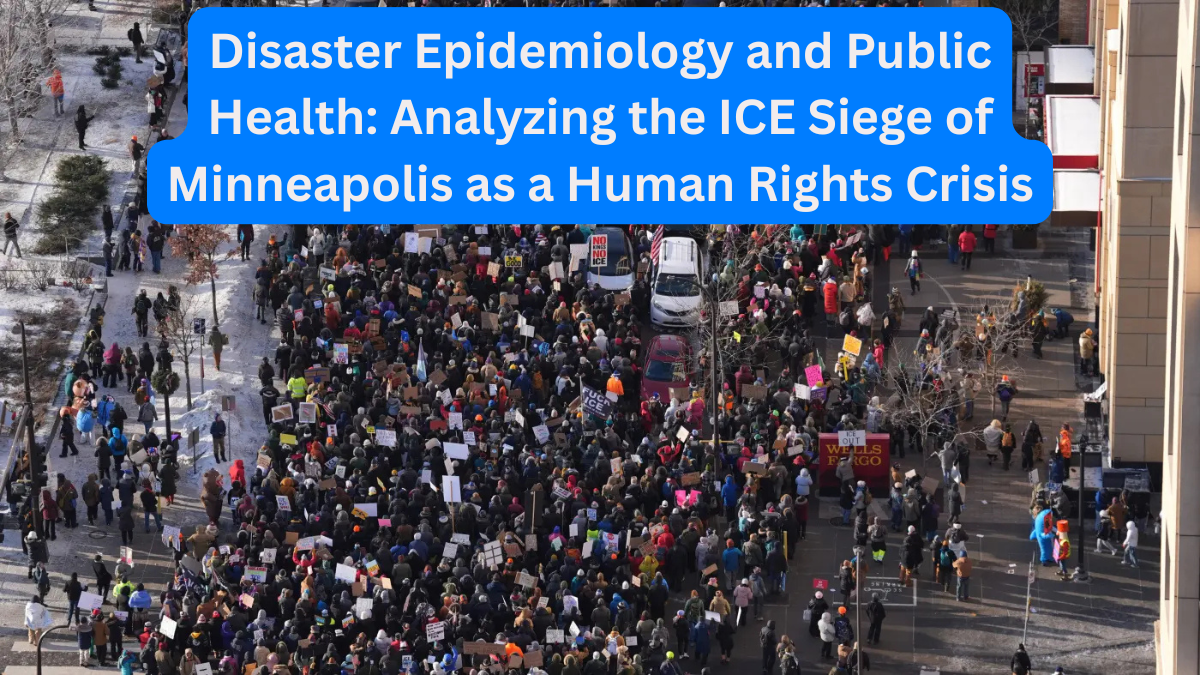
ICE Siege of Minneapolis as a Human Rights Crisis : Disaster epidemiology—the application of epidemiological methods to prevent, prepare for, respond to, and recover from disasters—provides a critical framework for understanding the severe public health crisis in Minneapolis stemming from U.S. Immigration and Customs Enforcement (ICE) operations. This article examines the ongoing ICE human rights violations in Minneapolis through a public health lens, detailing the impacts, legal breaches, and urgent community responses required to address this man-made disaster.
Applying Disaster Epidemiology to Man-Made Crises: The Minneapolis Case Study
Traditionally used for outbreaks and natural disasters, the tools of disaster epidemiology are essential for dissecting systemic violence. The ICE siege in Minneapolis represents a clear case where public health principles must be deployed to measure harm, protect vulnerable populations, and demand accountability.
Core Principles in Action: From Theory to Urgent Reality
Disaster epidemiology operates on systematic steps: defining the affected population, measuring health outcomes, identifying causes, and evaluating interventions. In Minneapolis, this translates to:
- Defining the At-Risk Population: Immigrants, communities of color, protesters, and essentially any civilian in targeted neighborhoods.
- Measuring Health Outcomes: Physical injuries from projectiles, chemical exposures, psychological trauma, and the downstream effects of disrupted healthcare and food security.
- Identifying Causal Relationships: Direct links between ICE tactics (raids, use of force, arrests) and specific physical and mental health injuries.
- Evaluating Interventions: Assessing the effectiveness of community warning networks, legal aid, medical response, and advocacy.
The Four-Phase Public Health Response to the ICE Siege
A comprehensive public health response follows a cycle of preparedness, response, recovery, and mitigation. Here is how each phase applies to the ongoing crisis.
Phase 1: Preparedness – Building Community Resilience
Effective preparedness integrates early warning systems, public education, and infrastructure fortification. ICE operations are designed to evade such systems, making community-led strategies paramount.
- Developing Early Warning Systems: Communities have utilized encrypted messaging apps and social media to rapidly share sightings of ICE activity, acting as a grassroots early-alert network.
- Conducting “Know Your Rights” Drills: Just as tsunami drills save lives, community trainings on constitutional rights during encounters with ICE are a form of disaster drill. These sessions cover:
- The right to remain silent.
- The right to deny entry without a judicial warrant.
- The importance of having emergency contact plans.
- Strengthening Healthcare Infrastructure: Local clinics and hospitals must be prepared for a specific injury profile common in political violence, including:
- Kinetic impact injuries (rubber bullets, bean bag rounds).
- Chemical agent exposure (tear gas, pepper spray).
- Blunt force trauma.
- Acute anxiety and psychological trauma.
Phase 2: Acute Response – Addressing Immediate Health and Legal Needs
The acute phase requires coordinated medical and legal triage to minimize immediate harm and preserve rights.
- Emergency Medical Response: Street medic teams and mobile clinics provide essential first aid, decontamination from chemical agents, and referrals for severe injuries.
- Mental Health First Aid: Frontline responders provide psychological first aid to address acute stress and prevent the progression to PTSD.
- Rapid Legal Intervention: Legal observers document interactions, and emergency hotlines connect individuals with attorneys to contest detention and ensure due process.
Phase 3: Recovery and Accountability – Healing and Seeking Justice
True recovery requires addressing trauma, rebuilding community trust, and pursuing accountability—a cornerstone of both public health and human rights.
- Long-Term Mental Health Support: Community-based support groups and culturally competent therapy are needed to address collective trauma.
- Legal Accountability Mechanisms: This includes:
- Filing complaints with oversight bodies.
- Pursuing federal and state litigation for civil rights violations.
- Advocating for congressional investigations.
- “Accountability from Below”: Community tribunals and public testimony forums ensure that narratives are preserved outside of official channels, which may seek to minimize events.
Phase 4: Mitigation – Policy Change to Prevent Recurrence
The ultimate goal is to prevent future sieges. This involves advocacy for systemic policy change at local, state, and federal levels.
- Advocating for Sanctuary Policies: Strengthening local ordinances that limit cooperation between city agencies and ICE.
- Push for Federal Oversight: Demanding stronger congressional and Department of Homeland Security oversight of ICE’s use-of-force and operational protocols.
- Public Health Research and Documentation: Continuing to rigorously document health impacts to build an irrefutable evidence base for policy arguments.
Documented Human Rights and Constitutional Violations in Minneapolis
The actions documented in Minneapolis violate both U.S. law and international human rights standards. The following table summarizes key legal instruments and their breaches.
| Legal Instrument | Article/Amendment | Protection Offered | Violation in Minneapolis |
|---|---|---|---|
| U.S. Constitution | 5th & 14th Amendments | Guarantee of due process and equal protection under the law. | Arbitrary detention, lack of access to counsel, deprivation of liberty without due process for immigrants and citizens alike. |
| U.S. Legal Standard | 4th Amendment | Protection against unreasonable search and seizure; use of force must be “objectively reasonable.” | Excessive force against protesters, warrantless searches in communities. |
| International Covenant on Civil and Political Rights (ICCPR) | Article 9 | Freedom from arbitrary arrest and detention. | Widespread arbitrary arrests during protests and raids. |
| ICCPR | Articles 19 & 21 | Rights to freedom of expression and peaceful assembly. | Dispersal of peaceful protests using chemical agents and projectiles. |
| UN Basic Principles on Use of Force | Principles 4, 5, 10 | Use of force must be proportional, necessary, and preceded by warning. | Use of less-lethal weapons on compliant individuals, failure to warn, disproportionate escalation. |
A Community Action Plan: Resources, Steps, and Key Contacts
For those seeking to help, prepare, or advocate, here is a structured action plan.
Step-by-Step: How to Stay Informed and Document Abuses
- Monitor Trusted Information Sources: Follow local community organizations (e.g., Navigator MN, ACLU of Minnesota) and independent journalists on social media for real-time alerts.
- Document Safely: If you witness an incident, prioritize safety. From a safe distance, you can:
- Record video horizontally, noting time, date, and location.
- Capture officer badge numbers, vehicle identifiers, and license plates.
- Narrate what you see factually.
- Report Through Secure Channels: Submit documentation to legal defense organizations like the American Immigration Council or National Lawyers Guild.
- Seek Immediate Legal Help: If you or someone is detained, contact an emergency hotline immediately. The ICE Detention Hotline is 1-888-351-4024.
Key Organizations and Official Links for Support & Advocacy
| Organization | Primary Focus | Contact / Link |
|---|---|---|
| ACLU of Minnesota | Legal defense, advocacy, Know Your Rights resources. | aclu-mn.org |
| Immigrant Law Center of Minnesota | Free legal services for immigrants. | ilcm.org |
| Minnesota Department of Health – Center for Health Equity | Addresses health disparities, potentially a channel for official complaint. | health.state.mn.us |
| Office of the UN High Commissioner for Human Rights | Submitting complaints about ICCPR violations. | ohchr.org |
| U.S. Department of Homeland Security Office for Civil Rights and Civil Liberties | Filed complaints for abuses by DHS agencies (ICE). | dhs.gov/crcl |
Frequently Asked Questions (FAQ)
Q1: What is disaster epidemiology, and how does it relate to ICE?
A1: Disaster epidemiology uses public health methods to study disasters. The ICE siege in Minneapolis is a man-made disaster causing injury, trauma, and death, making it a valid subject for this field to understand scope, impact, and solutions.
Q2: What are the most immediate health risks to civilians in Minneapolis from these operations?
A2: Immediate risks include severe physical injury from “less-lethal” projectiles (e.g., vision loss, fractures), respiratory damage from chemical agents, acute psychological trauma, and denial of medical care for chronic conditions due to fear of leaving home.
Q3: Do constitutional rights apply during ICE operations?
A3: Yes. The U.S. Constitution applies to all persons on U.S. soil. The 4th (unreasonable seizure), 5th, and 14th (due process) Amendments are routinely at risk during widespread ICE operations, as documented in Minneapolis.
Q4: How can communities physically prepare for such sieges?
A4: Preparedness includes creating communication networks, stockpiling essential medicines and food, establishing safe houses, training in first aid and legal rights, and coordinating with sympathetic healthcare providers for telemedicine.
Q5: What is “accountability from below”?
A5: It refers to justice mechanisms outside formal state systems, such as community-led documentation, people’s tribunals, and public narrative projects that ensure history is recorded accurately and pressure is maintained on official institutions.
Q6: Where can public health professionals contribute?
A6: They can help by documenting injuries and health impacts in standardized ways, providing expert testimony, advocating within health departments to declare this a public health crisis, and designing long-term trauma recovery programs.