


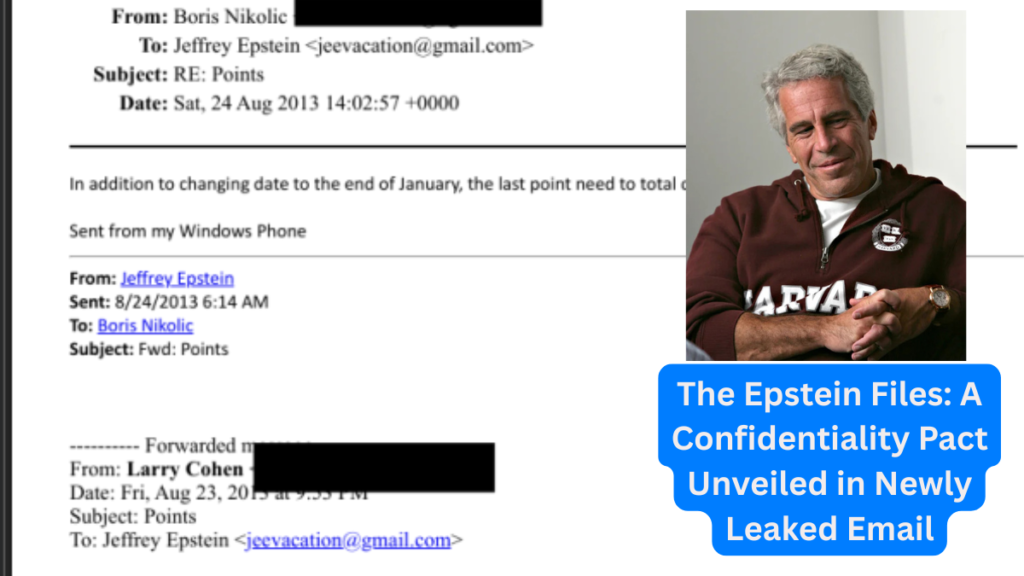
The Epstein Files: A Confidentiality Pact Unveiled in Newly Leaked Email: A newly surfaced email from the trove of documents related to Jeffrey Epstein offers a rare glimpse into the legal and interpersonal machinery that shielded the disgraced financier’s world. Dated August 24, 2013, the exchange—between Epstein and former associate Boris Nikolic—centers on the drafting of a pointed and restrictive agreement, underscoring the culture of secrecy that has long surrounded Epstein’s network.
The Email Exchange
The forwarded email, originally from a man named Larry Cohen to Epstein, outlines several “points” for an agreement, which Epstein then sends to Nikolic for input. Nikolic’s brief reply requests two changes: moving a date to “the end of January” and a total revision of the final point regarding help finding a job.
The draft agreement itself is striking in its scope:
- Mutual Non-Disparagement: Both parties agree not to disparage each other “privately or publicly.”
- Confidentiality: The agreement and its terms are to be kept confidential, with limited exceptions for accountants and tax preparation.
- Broad Legal Release: One party (presumably Nikolic) agrees to have “no legal claims” against Epstein, his family, or any related entities, including the foundation and bgC3—a company linked to Bill Gates—and their personnel. Epstein reciprocates the release of claims.
- End of Employment: It notes the end of employment with bgC3 effective January 1, 2014.
- Positive References: Epstein agrees to provide “positive references” via email, letter, or phone.
Reading Between the Lines
While short, this draft reveals several telling dynamics:
- Silencing Mechanism: The combination of a non-disparagement clause and a sweeping legal release is a classic tool to prevent former associates from speaking out or taking legal action. The requirement for “positive references” further incentivizes compliance.
- The bgC3 Connection: The mention of bgC3, a think tank founded by Bill Gates, ties this correspondence directly to the broader web of Epstein’s associations with wealthy and influential figures. Nikolic, a biotech investor, was a liaison between Gates and Epstein.
- Timing and Context: August 2013 falls within a period when Epstein was a convicted sex offender (following his 2008 plea deal) yet was still actively managing his network and agreements. This email suggests business-as-usual efforts to legally insulate himself and his circle.
The Bigger Picture: NDAs and the Epstein Strategy
This document is a microcosm of Epstein’s modus operandi. He frequently used Non-Disclosure Agreements (NDAs), settlements, and confidentiality pacts to muzzle victims, employees, and business contacts. The leaked draft highlights how these agreements were not limited to victim settlements but extended to professional relationships, creating a perimeter of legal silence around his activities.
Legal experts often note that while NDAs are common in business, their use to conceal criminal activity or harassment is unenforceable. However, the chilling effect remains powerful, often delaying or preventing disclosure.
Why This Matters Now
As the Epstein files continue to be unsealed and analyzed, documents like this email are crucial. They move beyond sensational headlines and provide forensic evidence of how secrecy was systematically built and maintained. They show the mundane, bureaucratic tools—emails, drafts, clauses—used to construct a fortress of impunity.
For the public and investigators, each fragment adds to the understanding of how powerful individuals can operate in the shadows. It also raises ongoing questions about the enforceability and ethics of such sweeping confidentiality agreements, especially when they intersect with matters of public interest and justice.
The Epstein saga is far from a closed case. It is a ongoing lesson in power, privacy, and the paper trails that eventually, inevitably, see the light.